
DDIM™ – Decision Data Integrity Model
Service
- Can that decision truly be called "justified"?
- DDIM™ (Decision Data Integrity Model) is a proprietary technology that structures decision-making processes involving both humans and AI, integrating assessments of their validity, transparency, and accountability based on mathematical models. It is neither merely an explainable AI solution nor a simple dashboard. DDIM™ addresses the fundamental question: "Why can this judgment be considered justified?" ※Jointly developed with the Japan Digital Advisory Strategy Council (General Incorporated Association)
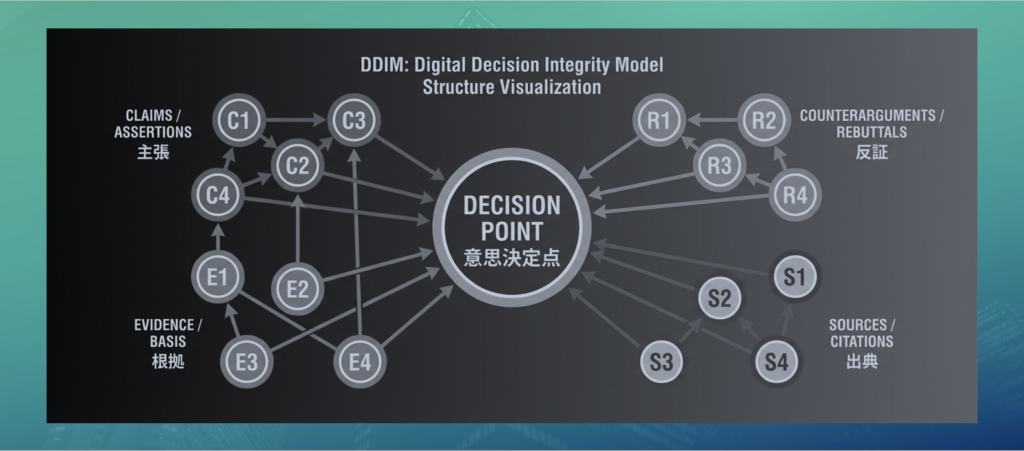
Viewing decision-making as a "structure"
DDIM™ treats decision-making not as an outcome, but as a structured entity comprising “Claim, Rationale, Counterargument, and Source.” By visualizing the flow of information underlying judgments, it transforms black-boxed decision-making into an analyzable state.
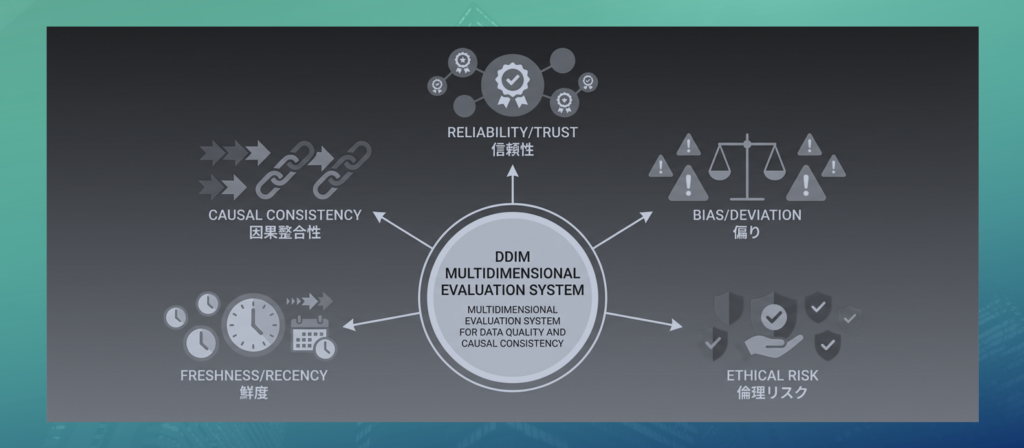
Multifaceted Evaluation of Data Quality and Causal Consistency
Each judgment factor is evaluated from multiple perspectives, including reliability, bias, ethical risk, freshness, and causal consistency. This multidimensional approach captures the “quality of judgment” that cannot be measured by a single metric.
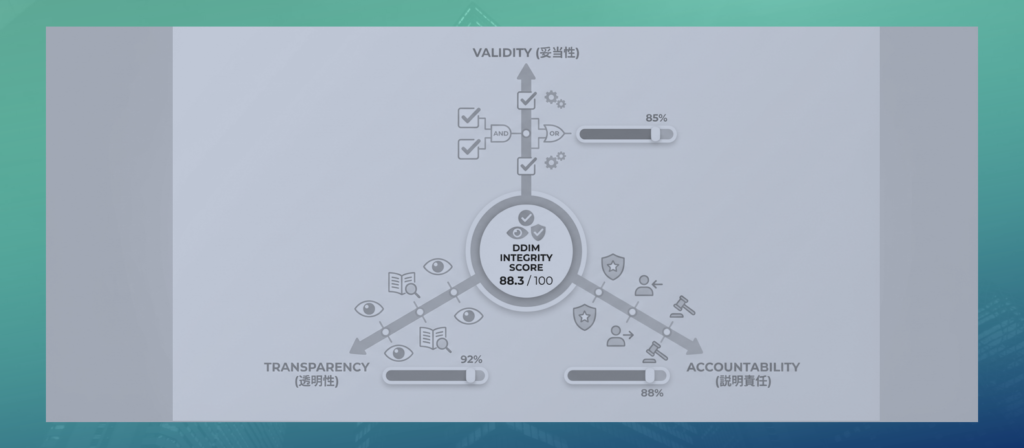
Calculation of Decision-Making Integrity Using Three-Axis Evaluation
DDIM™ comprehensively calculates decision-making integrity using three independent evaluation axes: Validity, Transparency, and Accountability.
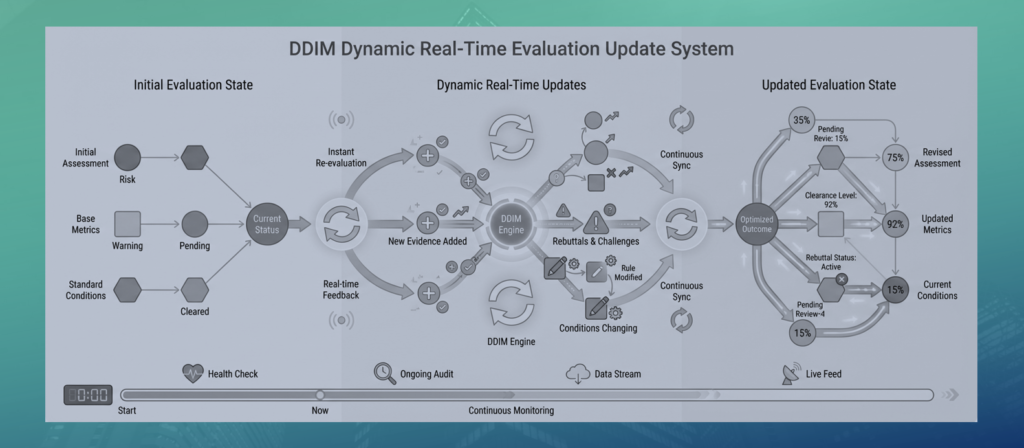
Dynamically Updated Decision Evaluation
Evaluation results are dynamically updated based on new evidence, counterarguments, or changes in decision criteria. Even during meetings or deliberations, you can always grasp the latest decision-making status.
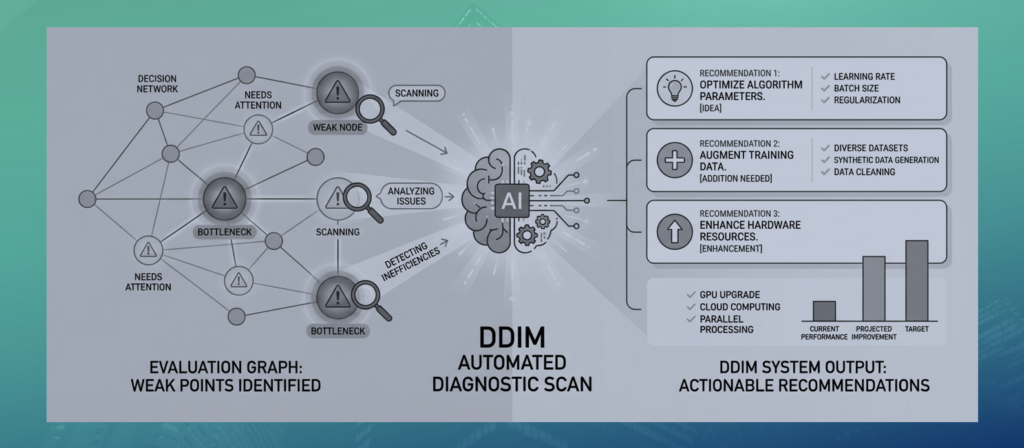
Automatically identify and present areas for improvement
Based on evaluation results, it automatically identifies “where weaknesses lie” and “what needs to be supplemented.” It presents improvement points to enhance the quality of decision-making.
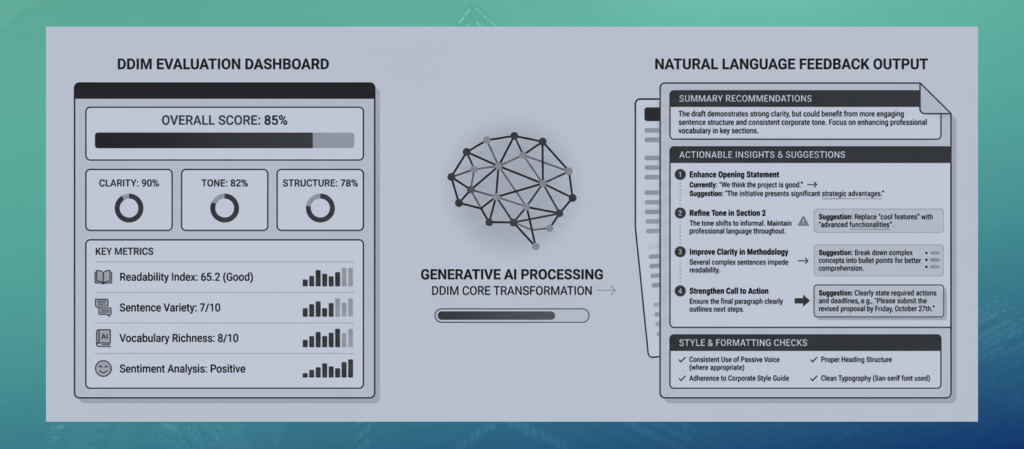
Generative AI-based natural language feedback
Improvement proposals are converted into natural language by generative AI and presented in a form understandable to anyone. They go beyond mere scores to indicate the next steps to take.
Method
- Toward an organization that can objectively explain the "correctness" of its judgments
- Massive Act liberates decision-making from intuition and subjectivity, elevating it to a "quality of judgment" that can be explained to third parties. DDIM™ is a technology that fundamentally underpins an organization's reliability across management, governance, and AI utilization. It is precisely because we are deeply familiar with project sites of all scales and scenarios that we have developed technology capable of contributing to essential decision-making.
Step
- step
- 1
Collection of Decision-Making Information
We organize and collect information relevant to decision-making, including meeting materials, AI proposals, data-driven evidence, and counterarguments.
- step
- 2
Visualization of Decision-Making Structures
Structure information and visualize the overall picture of decisions as a graph.
- step
- 3
Evaluation of Decision-Making Integrity
We quantitatively evaluate the state of decision-making from the perspectives of validity, transparency, and accountability.
- step
- 4
Identifying areas for improvement
Identify weaknesses and gaps in judgment, and clarify areas for improvement.
- step
- 5
Continuous Decision-Making Enhancement
Through continuous evaluation and improvement, we sustainably enhance the decision-making capabilities of the entire organization.